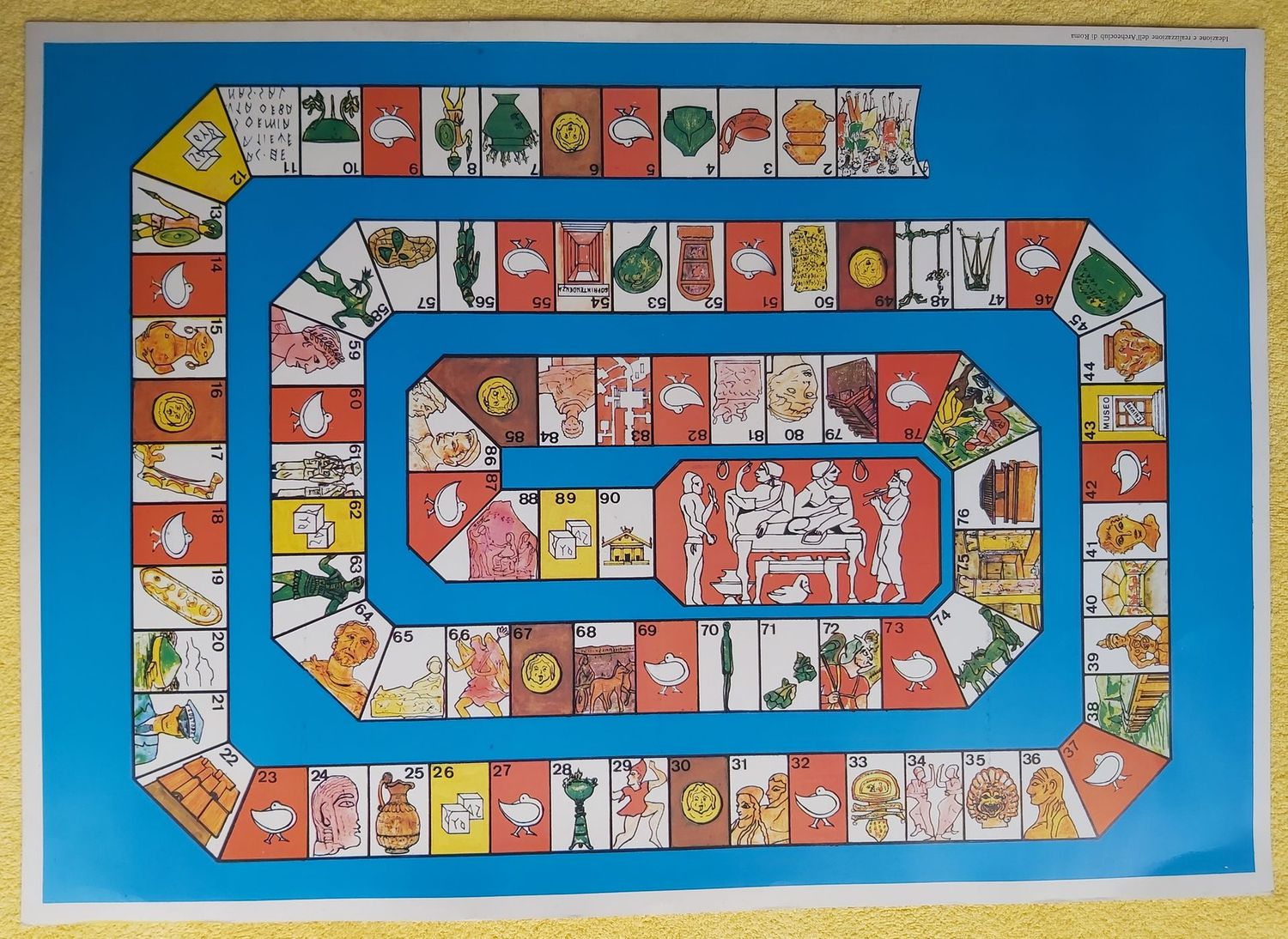
Gioco dell'Oca Archeologia Romana Etrusca Giuoco Ideazione e Realizzazione dell'Archeoclub di Roma. Questo è un gioco da tavolo a percorso, strutturato in modo simile al classico Gioco dell'Oca, ma con un tema incentrato sulla storia e l'archeologia antica (presumibilmente romana o etrusca, dato il design delle icone). Ecco le caratteristiche principali della tavola: la Struttura: Il percorso si snoda a spirale attraverso 90 caselle. Iconografia: Le caselle raffigurano vari reperti: Oche / Uccelli: Funzionano come le classiche caselle speciali che permettono di avanzare di nuovo (es. caselle 5, 9, 14, 18, ecc.). Reperti Archeologici: Vasi, monete, statue e templi che riflettono un contesto museale o storico. Caselle Speciali: alcune caselle presentano illustrazioni più complesse che probabilmente indicano regole specifiche (salti in avanti, fermate o ritorni alla partenza). Traguardo: la casella finale (90) raffigura un edificio stilizzato che sembra rappresentare l'ingresso di un museo, l'obiettivo ultimo dei giocatori. È un ottimo strumento educativo per familiarizzare con l'arte antica divertendosi.
Sul tabellone noterai delle caselle contrassegnate da un uccellino bianco su sfondo rosso (il logo dell'Archeoclub d'Italia). Queste sostituiscono le classiche "Oche". Se un giocatore atterra su una di queste caselle, raddoppia subito il movimento appena effettuato avanzando dello stesso numero di punti. Posizione: Si trovano a intervalli regolari lungo tutto il percorso (es. caselle 5, 9, 14, 18, 23, 27, 32, 36, 41, 45, 60, 82).
Le caselle arancioni e le illustrazioni rappresentano imprevisti o tappe della vita nell'Antica Roma: Casella 6 (Il Ponte / La Moneta): rappresenta una moneta d'oro antica. Di solito permette di saltare direttamente in avanti (spesso alla casella 12). Casella 19 (La Locanda / Il Mosaico): rappresenta il ristoro. Il giocatore si ferma per 3 turni a causa del "banchetto". Casella 31 (Il Pozzo / Reperto inabissato): si rimane bloccati nella casella finché un altro giocatore non ci capita sopra, "salvando" chi era caduto nel pozzo e prendendone il posto. Casella 42 (Il Labirinto / Le Mura): rappresenta la perdita dell'orientamento tra le antiche rovine. Si è costretti a tornare indietro fino alla casella 39. Casella 52 (La Prigione / La Colonna): il giocatore rimane bloccato all'interno del tempio/cella e deve rimanere fermo finché un altro giocatore non arriva a sostituirlo o finché non lancia un doppio con i dadi. Casella 58 (La Morte / Il Guerriero Ombra): atterrare sul mostro/guerriero verde alla casella 58 significa che la spedizione archeologica è fallita. Il giocatore deve ricominciare da capo tornando alla casella 1. Significato dei Reperti Didattici: le caselle neutre (bianche o gialle) mostrano diversi elementi della civiltà romana da commentare durante il gioco a scopo didattico. Caschi e Gladi (es. casella 13, 63): rappresentano l'esercito e i legionari. Anfore e Crateri (es. caselle 2, 3, 15, 25): richiamano il trasporto di olio e vino nel Mediterraneo e gli scavi subacquei. Iscrizioni e Lapidi (es. casella 11): rappresentano l'epigrafia latina, fondamentale per ricostruire la storia scritta dei monumenti.
Stato di Conservazione: ottime condizioni con lievi segni del tempo come da foto.
Misure: cm 63,8 x 45,25.
Anno: .
Peso: g .
(ENGLISH)
Roman Etruscan Archaeology Game of the Goose Game Designed and created by the Archeoclub of Rome. This is a board game, structured similarly to the classic Game of the Goose, but with a theme centered on ancient history and archaeology (presumably Roman or Etruscan, given the design of the icons). Here are the main features of the board: Structure: The path spirals through 90 squares. Iconography: The squares depict various finds: Geese / Birds: These function like the classic special squares that allow you to advance again (e.g., squares 5, 9, 14, 18, etc.). Archaeological Finds: Vases, coins, statues, and temples that reflect a museum or historical context. Special Squares: Some squares feature more complex illustrations that likely indicate specific rules (jumping forward, stopping, or returning to the start). Finish Line: The final square (90) features a stylized building that appears to represent the entrance to a museum, the players' ultimate goal. It's an excellent educational tool for learning about ancient art while having fun.
On the board, you'll notice squares marked with a white bird on a red background (the logo of the Archeoclub d'Italia). These replace the classic "Geese." If a player lands on one of these squares, they immediately double their movement, moving forward by the same number of points. Location: They are found at regular intervals along the entire path (e.g., squares 5, 9, 14, 18, 23, 27, 32, 36, 41, 45, 60, 82).
The orange squares and illustrations represent unexpected events or stages of life in Ancient Rome: Square 6 (The Bridge / The Coin): This represents an ancient gold coin. It usually allows you to jump directly forward (often to square 12). Square 19 (The Inn / The Mosaic): represents refreshment. The player stops for 3 turns due to the "banquet". Square 31 (The Well / Sunken Artifact): The player remains stuck on the square until another player lands on it, "saving" the player who fell into the well and taking their place. Square 42 (The Labyrinth / The Walls): represents the loss of orientation among the ancient ruins. The player is forced to go back to square 39. Square 52 (The Prison / The Column): The player remains stuck inside the temple/cell and must remain still until another player arrives to replace them or until they roll a double. Square 58 (Death / The Shadow Warrior): Landing on the green monster/warrior on square 58 means the archaeological expedition has failed. The player must start over, returning to box 1. Meaning of Educational Findings: The neutral boxes (white or yellow) show various elements of Roman civilization, which should be discussed during the game for educational purposes. Helmets and Gladi (e.g., boxes 13, 63): represent the army and legionaries. Amphorae and Craters (e.g., boxes 2, 3, 15, 25): recall the transport of oil and wine in the Mediterranean and underwater excavations. Inscriptions and Tombstones (e.g., box 11): represent Latin epigraphy, essential for reconstructing the written history of monuments.
Condition: Excellent condition with minor signs of aging, as shown in the photos.



 |
Questa azienda è presente anche su
|
Questa azienda è presente anche su  e
e 